


WITH TWO WEEKS to go before I head back to Sri Lanka to trek my final 7 stages of the Pekoe Trail, I’ve been spending a slightly embarrassing amount of time staring at my case and asking myself the same question over and over again: do I really need this?
Packing for a long distance trek is a balancing act. Take too much and every uphill section will feel twice as hard. Take too little and I’ll spend the next few days wishing I’d packed the thing I decided I could live without. In the past, I’ve generally erred on the side of caution and taken too much, only to discover that most of my carefully considered ‘essentials’ have never actually left my backpack.
Over the years I’ve made plenty of packing mistakes. I’ve carried spare chargers, too many T-shirts, socks, extra pairs of trousers in case I ripped the ones I was wearing. I’ve gradually learnt that some of the most valuable things in my pack aren’t necessarily the most expensive. In fact, some of the cheapest items have proved to be the things I wouldn’t now dream of trekking without.
So, with just a couple of weeks to go, here’s what will be making the journey with me this time, what I’ve finally learnt to leave behind and a few things that have earned their place in my increasingly carefully considered pack.
The Essentials
Boots
Walking boots with ankle support are now a non negotiable for me, even though some people prefer to trek in trainers.
Sri Lanka’s trails can throw almost anything at us: rocky paths, muddy tea estate tracks, slippery forest trails, uneven roads and sudden tropical downpours. Good footwear makes a massive difference.
I use Salomon boots because they give me the ankle support I need and, most importantly, don’t give me blisters. That wasn’t always the case. After twisting my ankle on a trek early last year, I learnt that particular lesson the hard way and converted to boots with proper ankle support and made sure they were well worn in for blister protection.
Wet Gear
I’ve learnt never to underestimate Sri Lankan weather. One minute we can be walking under clear blue skies and blazing sunshine and the next be absolutely drenched by a tropical downpour.
I’ve been caught out before and now carry a lightweight waterproof jacket even when the forecast looks promising. It also doubles as a windproof layer on cooler mornings in the hill country and takes up very little room at the bottom of my backpack.
Leech Socks
These are a must for me if there’s any chance of encountering leech life, which there almost certainly is on the Pekoe Trail. Even with leech socks on, there’s still a good chance I’ll get sucked at if I have bare arms. I’m told leeches are not particularly interested in personal boundaries!
Compeed
Possibly the smallest item in my bag but one of the most important.
On the first stage of my trek across Sri Lanka back in 2022, without Compeed my adventure would almost certainly have been over on day one. Fortunately, I had some with me and they saved the trek. I’ve never underestimated the power of a tiny plaster since. I now carry a couple, even when I’m out walking at home. You never know when an innocent looking blister is going to decide it has other plans for your day.
Sun protection
People often think of Sri Lanka as Sun, beaches, palm trees and ancient ruins, but even in the cooler hill country where I’ll be trekking, the sun can be relentless. My essentials are SPF 50 cream, sunglasses, a peaked cap and lip balm with SPF. My personal favourite is Heliocare. I’ve never burnt whilst wearing it and, unlike some sun lotions, it doesn’t leave me feeling as though I’ve been coated in cooking oil.
Insect Repellent
Leeches tend to get all the publicity, but mosquitoes can be just as irritating. A decent insect repellent is worth every penny and I also use DEET-free citronella soap which many locals swear by.
Phone and Camera
My phone has always been my camera, notebook and emergency contact system. This time, however, I’m also bringing my new compact camera in the hope of getting some great photographs, particularly of the wildlife. It will mean a little extra weight for me, but I’m hoping it will be worth every gram.
Basic First Aid Kit
Nothing elaborate, just the basics: painkillers, Ibruprofen, antiseptic wipes, plasters and antihistamine cream and tablets. Thankfully, my guide carries a more comprehensive first aid kit, including bandages, ice pack, emergency blanket which means I can keep mine small.
Food and Water
I generally carry enough snacks to keep my energy levels up between stops. Nuts, bananas and energy bars usually do it. Water is obviously critical, but one of the biggest lessons I’ve learnt is that carrying excessive amounts ‘just in case’ can add a surprising amount of unnecessary weight.
More on that later.
My Unexpected Must-haves
Some things sound unnecessary when you’re packing them, and others seem too small to make much difference. Yet over the years a few have become complete game changers for me.
Walking Poles
I resisted using walking poles for years. To be honest, I ignorantly assumed they were mainly for older walkers.
Then I tried them.
Now I wouldn’t want to tackle a long trek, particularly a long descent, without them. They reduce pressure on knees, ankles and most importantly for me, my hips. They improve my balance and are super helpful on uneven terrain, which is what much of the Pekoe Trail involves.
I’m still not entirely sure when I crossed over into being someone who gets excited about walking poles, but apparently it has happened.
Microfibre Cloth
Tiny, almost weightless and ridiculously useful.
It dries sweat, wipes condensation and dust from my glasses, cleans my phone screen, dries wet gear and generally earns its place several times over. It weighs almost nothing, which in backpack terms makes it practically perfect.
Arm Protectors & Gloves
Arm protectors became a revelation during hot weather trekking. They provide sun protection without having to constantly reapply sunscreen, help prevent scratches from vegetation on overgrown trails and can even reduce the chances of leeches attaching themselves to my arms or armpits. Yes, my armpits. Trust me - it is as unpleasant as it sounds.
Gloves are useful when scrambling over rocks, negotiating rough terrain or for preventing blisters when using walking poles for long periods.
Small Zip Bags
The humble zip bag is one of the most useful things I carry and weighs virtually nothing. They keep my electronics dry, help organise small items, separate wet gear from dry and prevent the contents of my backpack descending into complete chaos. For something that costs almost nothing, they earn their place every time.
Electrolytes
Electrolytes are one of the simplest additions to my kit and one of the most effective. When trekking in heat and humidity, replacing the salts lost through sweating makes a real difference to my energy levels and recovery. A few electrolyte tablets take up almost no room but can make a big difference at the end of a long day.
What I’m Leaving Behind
Experience has taught me that successful trekking is as much about what you choose not to take as what you do.
The ‘Just in Case’ Pile
I’ve realised that my backpack becomes heavier mostly because of ‘what-if’ anxiety.
What if I need this? What if I need that?
Before long I’m carrying several kilos of things that never actually leave the sack. Nowadays I’m much more ruthless. If I’m very unlikely to use something, it stays at home or goes into the larger bag that’s couriered ahead to my next destination. There is something very liberating about admitting that I probably won’t need three different options for the same thing.
Too Many Clothes
I’ve learnt that nobody on a trekking trail cares whether you’ve worn the same shirt twice. Or three times. Possibly even four.
I now choose lightweight, quick drying clothing, which means fewer items are needed and there’s less washing to worry about. On a trek, I’ve realised that nobody is judging my outfit. They’re generally far more interested in chatting, sharing stories or finding a shady spot.
Heavy Power Banks
Technology has improved enormously and there are now excellent lightweight power banks available that provide plenty of phone charge without adding unnecessary weight. Every gram matters when you’re carrying everything uphill, so my heavy power banks have been given the boot.
My Biggest Weight-Saving Lessons
After trekking more than 1000km across Sri Lanka, these are probably some of the most valuable packing lessons I can share with you.
Think About How You Pack
I’ve found that placing lighter items at the bottom of my backpack and heavier items closer to my back, around the middle to upper part of the bag, makes it feel much more balanced and comfortable to carry. In the past I’ve packed the other way around with heavy stuff at the bottom and it’s dragged my bag down and caused me lower back pain after a while. It sounds like a small thing, but when you’re walking for hours it makes a surprising difference.
Carry Less v Ultralight Everything
There’s a huge industry dedicated to convincing trekkers they need expensive ultralight gear. I’m sure some of it is excellent, but in my experience simply carrying fewer things saves more weight than spending a fortune replacing perfectly good equipment.
My most effective weight saving strategy has generally been to ask myself whether I actually need something before worrying about whether I can buy a lighter version of it.
Know where I can refill water
Water is heavy and very heavy when you have to carry it uphill. If I know there are reliable places to refill along the route, I’ll carry less and top up as I go. Of course, this requires planning and trail knowledge from my guide, but it can be a massive weight-saver.
That said, if I’m unsure, I’ll always carry extra water. This is probably the area where I struggle most to save weight because I’d rather carry a little too much than run out. There are some things I’m prepared to be ruthless about. Dehydration isn’t one of them.
Consider a Smaller Bag
This might sound obvious, but a smaller backpack physically limits how much I can take.
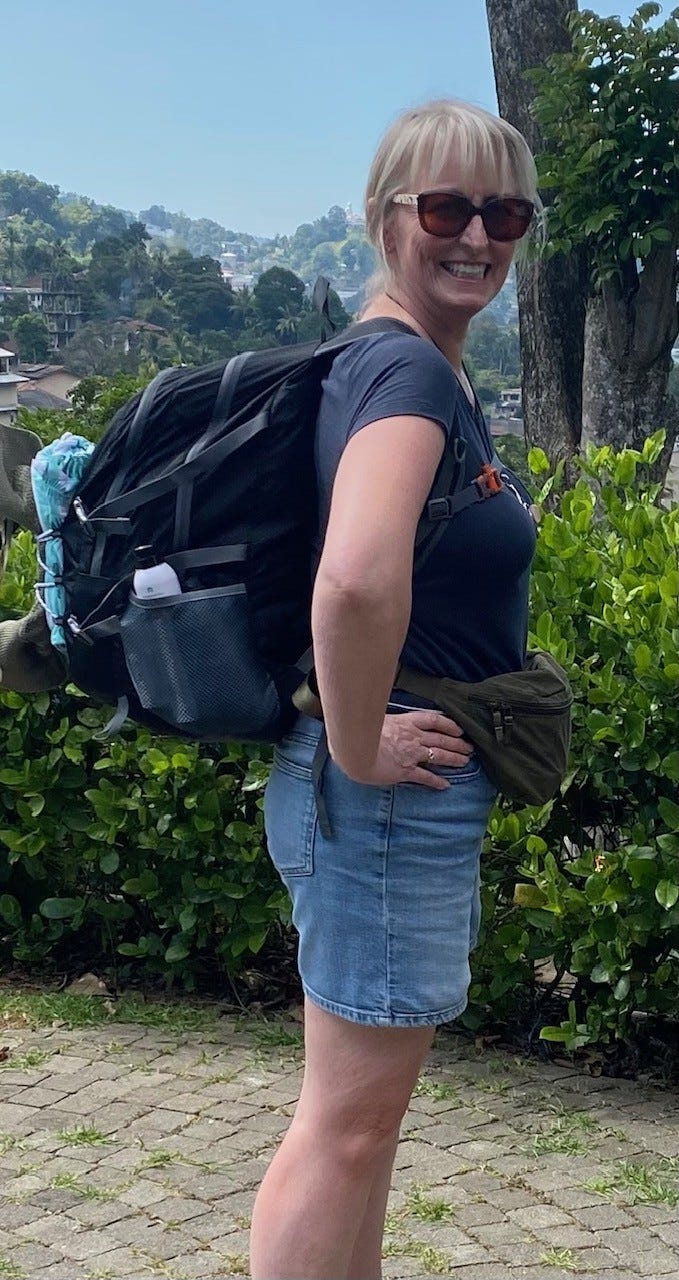
So this time I’m taking a smaller pack and having a slightly larger bag transported ahead to my next destination.
If there’s space available, I think it’s only natural that we tend to fill it. Give me a big backpack and I’ll somehow find a reason to put things in it. Give me a smaller one and suddenly I discover that I can survive without half the contents of my cupboard.
Final thoughts
Every trek has taught me something new. The longer I walk, the more I realise that successful trekking is about carrying only what you really need, leaving behind what you don’t and learning from past experiences.
One of the biggest things I’m hoping will make this trek more manageable for me is that I’ve been able to shed quite a few kilos in body weight. My hips, knees and ankles will appreciate carrying a little less of me up the hills. The challenge now is making sure I don’t use those saved kilos as an excuse to pack a few extra ‘non essential’ items.
I’d love to know what’s the one item you would never trek without, especially if it’s lightweight and doesn’t take up much space? Or what’s the one thing you thought you absolutely needed but never did?
Please subscribe to this Substack to receive new articles directly into your email or share with a friend who perhaps has plans to travel to Sri Lanka. Just press ‘no pledge’ when prompted as it’s free.
Last year
Don't forget a spare SD card(s) and charger for your new camera! They'd absolutely be on my "essentials" list! Xx